How we avoid mid-air collisions
Updated: Apr 8, 2025
With global air travel growing day by day, currently the world averages approximately 150,000 commercial flights per day.
Our skies are becoming more and more congested yet mid-air collisions are a rarity, albeit recent events have brought this threat to the forefront of our mind. The question is how does this global highway do it so effectively day in, day out.
Aviation is one of the most regulated industries in the world, ICAO (International Civil Aviation Organisation) is a global organisation that brings nations together and provides a framework set of guidelines that individual national aviation authorities should adhere too. It goes without saying that safety forms the foundation of the aviation industry and encompasses every action.
Separation
Aircraft can be separated vertically and laterally, the amount of separation varies depending on what airspace you are in, but in general terms the separation standards in accordance with ICAO Doc 4444 are:
Vertical separation - 1,000ft
Aircraft should be separated by 1,000ft vertically below FL290, above FL290 this increases to 2,000ft.
The above paragraph can vary if the aircraft is operating in RVSM airspace (Reduce Vertical Separation Minima). This is airspace where aircraft, air traffic controllers and pilots must meet a specific criteria, standard and be equipped with certain equipment in order to operate to the lower vertical separation criteria of 1,000ft. RVSM airspace is now in widespread use across the globe where ATS surveillance systems exists.
Lateral separation - 5nm
Aircraft should be separated by 5nm horizontally, this is a general figure, in reality this number varies significantly depending on the type of airspace it can go as low as 2.5nm. In areas outside of ATS surveillance systems lateral separation has to be done based on time, a good example of this is when crossing vast stretches of ocean and radar coverage is limited.
How is this managed?
Air Traffic Control (ATC) is primarily responsible for ensuring that aircraft remain adequately separated, they can do this through giving commands to pilots to control an aircrafts heading, speed and altitude, they will also give pilots a heads up as to any traffic in their immediate proximity which may flag on their TCAS system (I'll come onto TCAS shortly), hence giving pilots increased situational awareness. It's important to note that ATC's responsibility to keep aircraft separated can be alleviated depending on the type of airspace and the rules under which aircraft are flying in. Its important for pilots and controllers to be aware of what rules and services are in force to ensure the correct level of alertness by the right people for maintaining traffic separation.
Prescribed flight paths - The globe is full of set flight paths to help aircraft navigate safely, these need to be correctly interpreted and accurately flown to ensure inherent separation.
High workload and the number of variabilities can leave humans open to slips. That's when we use technology to provide an additional safety net.
TCAS (Traffic Collision Avoidance Systems)
TCAS is an electronic system that was brought into widespread use in the early 1990's it is a system that works off the aircrafts inbuilt transponder specifically Mode S to interrogate and receive replies from other transponders to calculate another aircrafts slant range, altitude and relative bearing.

With this data the TCAS computer calculates a time to reach the closest point of approach (CPA), the time parameter is the main parameter that will prompt the annunciation of an alert to the flight crew, the TCAS system can issue two types of alerts:
Traffic Advisories (TAs) - This will typically generate an aural alert in the flight deck 'TRAFFIC TRAFFIC' combined with an amber target on a display similar to the picture below.

A TCAS TA does not prompt pilot input however it assists the pilots in the visual search for the intruding aircraft and should prepare the flight crew for a possible resolution advisory (RA).
Resolution Advisory (RA) - An RA is generated when both aircraft are equipped with TCAS II. Both TCAS's co-ordinate their next move through the Mode S datalink, it will typically command one aircraft to climb and the other to descend, it commands this via a visual queue and an aural alert.
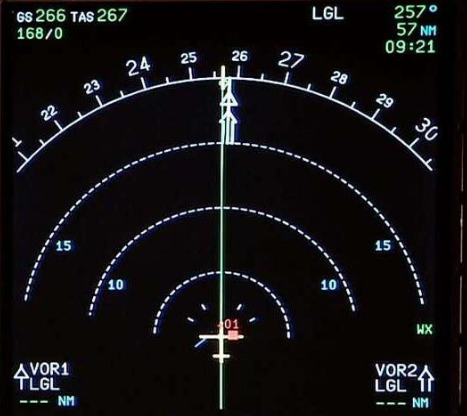
A red square indicates a TCAS RA has been triggered.

Combined with the visual red square an aural alert will prompt the flight crew to either climb or descend and the green highlight on the vertical speed indicator to appear, the green zone must be reached to assure the safe resolution of the conflict.
In some aircraft the autopilot will fly this maneuverer autonomously.
In 2021 Eurocontrol featured the non-compliance of TCAS RAs in its top 5 operational risks, although this has since been downgraded, likely due to the increased focused on practicing TCAS manoeuvres in airline pilot recurrent training and in more recent times the introduction of TCAP (An Airbus initiative with autonomous initiation of TCAS RAs) an equal threat remains that the over correction of a TCAS RA can led to a secondary conflict, through a recent FAA study it shows that the majority of conflicts are resolved with just a +/- 300ft altitude deviation. So the recovery to level flight post a TCAS RA is equally as important, in recent times a number of changes have been incorporated to the subsequent 'CLEAR OF CONFLICT' alert and 'LEVEL OFF' commands.
Regulations
In broad terms since the early 2000's TCAS was mandated on all fixed wing across most of the globe on turbine aircraft with a maximum take off mass exceeding 5,700kgs or maximum approved passenger seating configuration of more than 19. Equally ICAO mandated the carriage and use of pressure altitude reporting transponders ensuring that even aircraft not equipped with the TCAS computer would remain visible to other aircraft with TCAS.
Workload management, situational awareness, communication, knowledge, flight path management are a few of the key competencies required to mitigate the risk of mid-air collisions. Navigating in and out of busy, congested airspace adds to workload and inturn can reduce situational awareness all this without taking into account some of the factors addressed above. Its important that aeronautical information is clearly displayed on maps and charts to enable a natural way for pilots to capture the most important pieces of information and build it into their briefs to properly aviate, navigate and communicate, equally being competent with the technology on the flight deck and use it effectively to create a safer environment.
If you would like to learn more or think we can help then please reach out to us and we would be glad to continue the conversation.


Comments